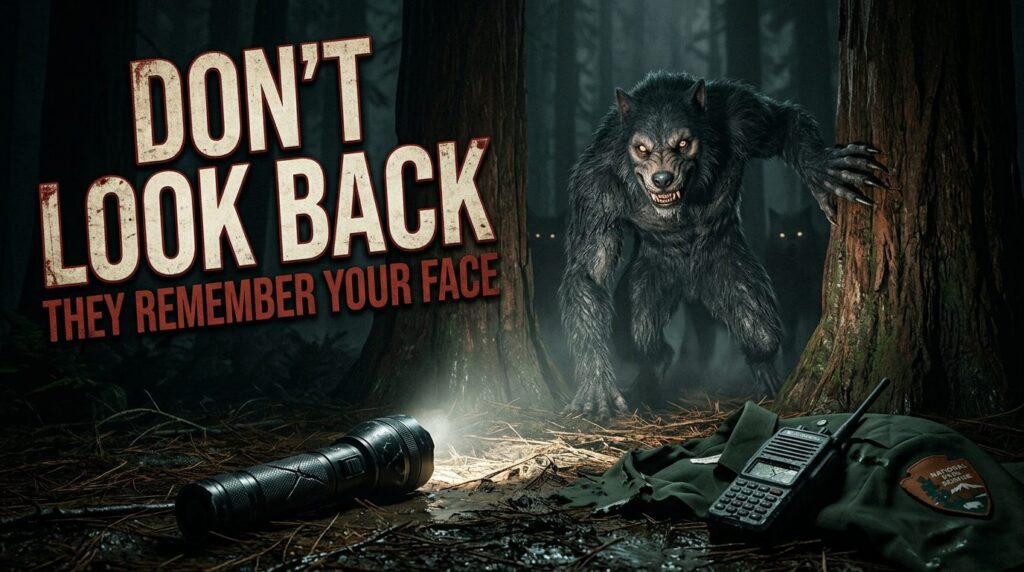
The rules of the forest are simple: be off the trail before dark. If you hear something that sounds like a dog barking in the distance, don’t look back. And if that sound suddenly stops—run.
What they don’t tell you is that the worst things aren’t the ones you might see. It’s the ones that have already been found, documented, and buried. Rangers sign nondisclosure agreements. Search teams get reassigned. Incident reports vanish. But the ones who saw them—the ones who survived—they never talk about it.
Until now.
THE STORY
Tongass National Forest, Alaska. November 1998.
The last thing Ranger Daniel Whitaker wrote in his patrol log was: “Something is following the truck. Not a bear.”
Three days later, his patrol vehicle was found at the end of a logging road, engine still running. The driver’s side door was open. The radio inside was stuck playing a seventeen-second recording on a loop—something breathing, heavy and wet, accompanied by a low-frequency tremor that sounded almost like laughter.
Daniel Whitaker is still listed as missing. Case number AK-4471. Closed as “wildlife encounter.” No body. No blood. Just hand-shaped dents in the steering wheel, as if something had grabbed it from outside and squeezed until the metal warped.
And the most disturbing detail never included in any public report: in those seventeen seconds, just before the breathing stopped, there was a voice. A human voice. Whispering one word.
“Run.”
Rule One: Don’t Look at Its Face
Six Rivers National Forest, California. Deep in the redwoods.
In 2011, a four-person biological survey team entered an area local tribes called “The Wailing Valley.” The official assignment was to document endangered owl populations. But the team lead told them privately: they were looking for something else.
“The last team didn’t come back,” he said. “That was three years ago.”
On the third evening, they found the previous team’s campsite. Tents intact. Sleeping bags neatly rolled. Food untouched in the packs. No signs of struggle. But on the tree bark surrounding the camp—seven feet above the ground—there were claw marks. Five parallel grooves, cut deep into the wood, spaced too wide for any known North American predator.
Then they heard it. Rising from the canyon floor. Not a howl—a howl is something you can understand, a wolf, a coyote, an animal claiming territory. This was something else. It started as a low chest vibration, then slid into a register that almost sounded like a child crying in the distance, muffled by something covering its mouth.
The team decided to evacuate immediately. As they ran back along the trail, the man at the rear stopped. He later testified that he saw a pair of eyes. Between the redwood branches, about twelve feet up. Not reflecting light. Emitting it. Dim amber, pupils contracted into vertical slits in the darkness.
The thing didn’t move. It just watched them.
It let them run.
Rule Two: The Smell Is the First Warning
San Benito County, Texas. Summer 2012.
Ruben Bejaran and his brother were night fishing for alligator gar along a river tributary. They’d heard their father had seen something rolling near the water a few days earlier. They wanted to confirm it—maybe get lucky.
Around two in the morning, Ruben’s flashlight swept across the brush on the opposite bank. He saw a shape. Upright. About six and a half to seven feet tall. Too thin. Arms disproportionately long, hanging past the knees. It was facing away from them, bent over doing something—Ruben didn’t want to know what.
Then it stood up.
“The way it stood up was wrong,” Ruben recalled. “Not the way a person does. Its spine curved, then the whole thing snapped straight. No hands pushing off the ground. Like something inside it pulled it upright.”
It turned its head.
Ruben said he didn’t see the face clearly. He didn’t want to. What he could see was—the way its head rotated on its shoulders was too smooth, like an owl. Then it ran.
“Not running. It was moving on all fours, but the front limbs moved like a person doing push-ups while being dragged by something. The speed—I’ve seen a lot of fast animals in Texas. This wasn’t any of them.”
His brother’s phone captured a blurry video. Officially identified as “possibly an escaped large canid.” Ruben kept that video for years. He said he sometimes wakes at three in the morning, opens it, and pauses on a single frame.
“In that frame, you can see the reflection in its eyes when it turns its head. You can see its mouth is slightly open.”
“But what keeps me awake isn’t what it looks like.”
“It’s that when it turned, it was already looking at us. Before we saw it, it knew we were there.”
Rule Three: It Remembers Your Scent
Manistee National Forest, Michigan. Fall 2019.
Ethan Marshall was on patrol one October night. Temperatures dropping, no one else on the forest roads. He had his high beams on, holding about twenty-five miles per hour.
Then he saw something in the middle of the road.
“My first thought was someone pranking me. A person in a Halloween costume. But you see the proportions and you know. Its shoulders were too wide. Its legs—the direction its knees bent was wrong. Like dog knees on a human body.”
The thing was about seven feet tall. Body covered in thick fur, dark gray, silvered under the headlights. But what made Marshall hit the brakes were its eyes.
“Yellow. Not animal yellow. The kind of yellow you see in a pair of eyes when it knows what you’re thinking.”
It didn’t run. It slowly turned, dropped onto all fours, and disappeared into the trees at a speed Marshall couldn’t process. No sound. A seven-foot thing, hundreds of pounds, running through dry leaves, making no sound.
The next day, Marshall and his colleague Sam went back to check. They found tracks. Massive, five toes, but the middle three were unusually long, with clear claw marks at the tips. Stranger still: the tracks stopped at a certain point. Not turned. Not covered by leaves. Just gone.
“Like it jumped.”
They started investigating. Then things went wrong.
Sam broke first. He said he saw eyes outside his window every night. Outside his second-floor window. Four nights straight. On the fifth day, he took leave and moved to his sister’s house.
“Before he left, he told me one thing. He said, ‘It’s not looking for me. It’s marking me. It’s letting me know it knows where I am. Then it’ll come for you.'”
Marshall didn’t wait for that day. But he was never really safe either. He said once he came home and found mud on his front screen door. Handprints. But not at the doorknob height. At the top of the doorframe. Seven feet off the ground.
“It came. It tried. The door didn’t open. But it was telling me it tried.”
Rule Four: Never Go Alone
Shoshone National Forest, Wyoming. January 2023.
A rancher set up night-vision cameras by his fence line after losing two calves on consecutive nights. On the third night, he saw them.
Six of them in the frame. They formed a semicircle, slowly closing in on the fence. They moved in perfect synchronization. Not the loose formation of a wolf pack. Something organized.
The lead one—the largest—stopped about thirty feet from the fence. It stood upright. The camera caught its face.
The rancher refused to release the full image. He described only one thing: “Its mouth. Its mouth wasn’t closed. Too many teeth. And the shape of its mouth—it was like a smile. But worse. Like it was imitating a smile.”
He fired three shots. He said he heard something in response. Not a howl. A scream. But from multiple directions. They were screaming together. Then they ran. Split up. In different directions.
“They weren’t fleeing. They were dispersing. Like they were executing a plan.”
The next morning, he found the remains of one calf outside the fence. Not eaten. Arranged.
“Legs up. Organs placed in a circle around it. The head in the center, facing my house.”
He sold the ranch and moved to Idaho. He said he’s never gone back.
Rule Five: If You Hear Laughter, You’re Already Too Close
San Benito, Texas. New Year’s Eve 2018.
Joseph Martinez’s family was having a party in their yard. His aunt went outside for air. She came back crying.
“She was shaking all over. She said she saw a man walking along the road. She thought it was a neighbor. Then she got closer. She said when it turned its head—the way its neck turned, like it had no bones—she saw its face.”
“She said it wasn’t a face. It was a mask. But something underneath was moving.”
Martinez and several relatives drove out to look. They followed an irrigation canal for about thirty minutes, then the headlights caught it.
“It was crouched by the canal. Thin arms. Wide shoulders. Grayish-brown skin. Some hair on its back, but sparse. Its head was bald. Completely bald. Like something skinned.”
It tried to avoid the headlights. It covered its face with its arms. Then Martinez saw its hands.
“Fingers too long. Too many joints. The way the fingers bent, like it was grabbing something invisible.”
They called the police. Before the police arrived, a car slid into a ditch. By the time they reorganized, the thing was gone.
Martinez said they never went back to that area. “We don’t even take that road. We go around. Twenty extra minutes, we go around.”
Why They Don’t Talk About It
There’s a pattern. If you spend enough time digging through semi-official records, retracted testimonies, anonymous ranger forum posts—you see the pattern.
The ones who actually experienced it—not the ones who caught a glimpse from a distance, but the ones who got close—they almost never speak publicly.
Not because they’re afraid of ridicule.
Because they’re afraid of being found.
Every ranger I’ve spoken to, everyone who’s seen the official files, everyone who signed an NDA, said the same thing: it knows who saw it. It remembers. And it waits.
There’s a saying that circulates among rangers, never confirmed, never fully denied:
In every national park where a “wildlife attack” has occurred, there’s an area that gets permanently closed. No announcement. No sign. Just one day, the trail stops being maintained. Maps get updated. Patrol routes change. Then, about three to six months later, the relevant files get reclassified.
And the ones who get reassigned—the rangers who get transferred—they’re required to sign a fourteen-page nondisclosure agreement. Section eight reads: “Unauthorized discussion of event-specific sensory details is prohibited, including but not limited to: sounds, smells, visual imagery, and any form of biological evidence.”
I’ve read this agreement. At the bottom of section eight, there’s a footnote in tiny print:
“Violators will face appropriate legal consequences. Additionally, please note: certain parties involved in these events have elected to no longer respond to any form of inquiry.”
No longer respond.
Not refuse to respond. No longer respond.
The Final Warning
If you’re in a national park, and it starts getting dark, and you hear something in the distance—like a dog, but not a dog; like laughter, but too low; like someone calling your name, but the pronunciation is wrong—
Don’t look back.
Don’t run.
Stop. Back away slowly. Don’t turn around. Don’t let it see your face.
Because if you see it, it remembers you.
And it will.
It’s always watching. If you made it this far, you already know. Those images still turning in your head after you turn off the lights—that’s not an accident. That’s the pull.