What the Official Report Left Out, and Why the Story Keeps Getting Retold
🔴 #WidowmakerPass 🩸 #CryptidHorror 🌲 #TheNightmareZoo
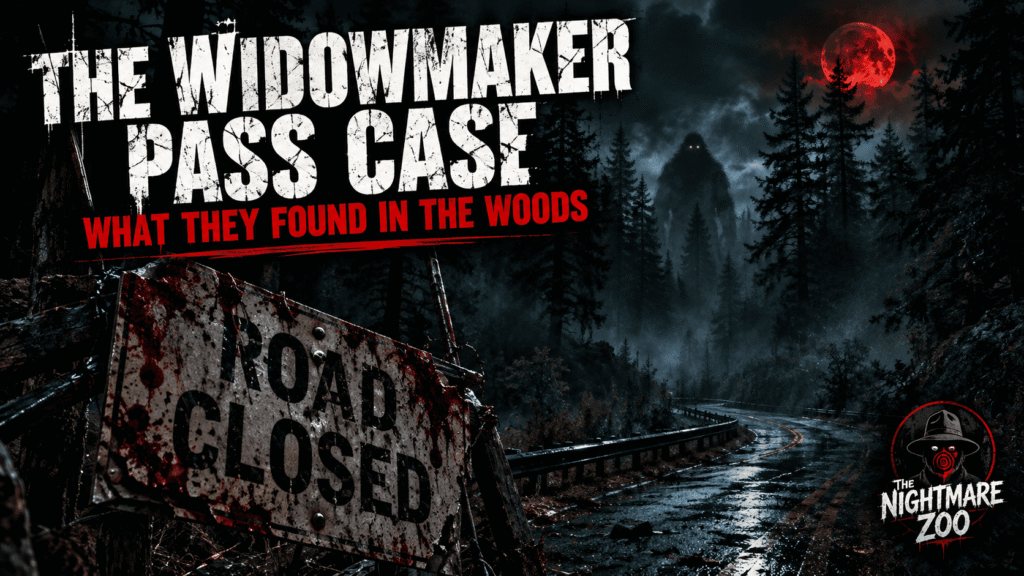
In 2019, the United States Forest Service closed a twelve-mile stretch of highway in the Bitterroot Mountains of Montana. The official reason was a rockslide. The road never reopened. But here’s what they don’t tell you—the rockslide was real, but it wasn’t the reason. Six people went into Widowmaker Pass that October. The search and rescue teams found pieces of four. What they found in the trees, what they heard on the emergency radio frequency at 3:47 AM, what they saw carved into the bark of a two-hundred-year-old ponderosa pine—that’s what sealed the road. That’s what they buried. And that’s what I’m about to tell you, because the story keeps getting retold for a reason. Because it’s true. And because whatever lives in Widowmaker Pass is still there.
It started with a hunting trip. That’s how these things always start in Montana, don’t they? A group of friends, a long weekend, a cooler full of beer and venison jerky, and the kind of confidence that only comes from men who’ve spent their whole lives in the woods. They were from Missoula—five of them, all between twenty-eight and forty-two, all experienced hunters who’d bagged elk in those mountains for years. The sixth was a woman named Danielle Reyes, a wildlife biologist from Bozeman who’d been invited along to document the trip for a documentary she was pitching about predator-prey dynamics in the Northern Rockies. She was the one keeping notes. She was the one who brought the satellite phone. She was the one whose audio recorder survived.
The group left Missoula on the morning of October 12th, 2019. They drove west on Highway 200, then turned north onto a Forest Service road that wound up into the Bitterroots. The pass itself—Widowmaker—sits at about 6,800 feet, a narrow cut through granite that’s been the site of at least eleven fatal accidents since the road was built in the 1950s. The locals call it Widowmaker because of what it does to marriages. You lose someone up there, the grief never really leaves. The mountain keeps a piece of you.
They set up camp about two miles below the summit, near a creek that fed into the Bitterroot River. The first night was uneventful. They drank, they told stories, they talked about the elk they’d seen on the game cameras. Danielle recorded ambient audio for her documentary—wind through the pines, the creek, the distant call of a great horned owl. Nothing unusual. Nothing that would make anyone listening back later feel like they were hearing a warning.
The second day, they split up. Three of the men—Ryan Kowalski, his brother-in-law Tom Brennan, and a friend named Derek Simmons—went east toward a ridge where they’d seen fresh sign. Danielle stayed at camp with the remaining two, a quiet man named Paul Hendricks and his cousin, a former Marine named Chris Delgado. Paul and Chris were going to hike a shorter loop, maybe a mile and a half, to check a trail camera they’d set up the month before. Danielle was going to stay at camp, organize her notes, and record more ambient audio.
She was alone for about two hours. She said later—in the interviews she gave before she stopped giving interviews—that nothing happened during that time. The camp was quiet. The fire was warm. She made coffee on the portable stove and watched the light shift through the trees. But she also said that around noon, the birds stopped singing. All at once. Like a switch had been flipped. She didn’t think much of it at the time. In the mountains, birds go quiet for all kinds of reasons. A hawk, a fox, a human passing through. But she noticed it. She wrote it down in her notebook. 12:14 PM—silence. No birds. No squirrels. No wind.
Paul and Chris came back around 1:30. They were laughing about something, carrying the trail camera. They’d gotten good footage, they said. A black bear, a few elk, a coyote. Nothing they hadn’t seen before. They downloaded the footage onto Danielle’s laptop and went to help her with lunch. The three of them ate, talked about the afternoon plans, and then Paul said he was going to take a nap. Chris decided to walk down to the creek and try some fly fishing. Danielle went back to her notes. It was 2:15 PM.
At 2:47 PM, Danielle’s audio recorder picked up something. She was wearing a lapel mic, and the recorder was running continuously. The audio is distorted, but you can hear it. A sound like a branch snapping—not a small branch, something thick, something heavy. Then a low, guttural vocalization. It’s not a bear. It’s not a mountain lion. It’s not a wolf. It’s something else. Something that sounds almost human, but wrong. Too deep. Too long. Too knowing. The sound lasts for about four seconds, and then there’s silence again.
Danielle didn’t hear it at the time. She had headphones on, listening to music while she worked. But the recorder caught it. And later, when the audio was analyzed by a bioacoustics specialist at the University of Montana, she said the closest match was a primate—but not any primate native to North America. She said it sounded like a chimpanzee in distress, but larger. Much larger.
At 3:12 PM, Chris Delgado stopped fishing. He told Danielle later that he felt like he was being watched. He said the hair on the back of his neck stood up, and he turned around slowly, expecting to see a bear or a cougar. But there was nothing. Just the trees. Just the creek. Just the sound of water moving over rocks. He packed up his gear and walked back to camp. He didn’t run. He walked. But he walked fast.
At 3:45 PM, the three hunters—Ryan, Tom, and Derek—returned to camp. They were excited. Ryan had shot a bull elk, a big one, and they’d field-dressed it and hung it from a tree about a mile and a half east of camp. They’d come back to get the truck and the game cart. They were going to bring it in before dark. Danielle offered to go with them. She wanted to film the retrieval for her documentary. Ryan said sure. Tom and Derek said they’d stay at camp and start dinner. Paul was still napping.
Danielle and Ryan left at 4:00 PM. They took the truck as far as the road allowed, then hiked the rest of the way. The elk was exactly where they’d left it, hanging from a gambrel stick, its body cavity open and steaming in the cold air. Danielle filmed Ryan as he lowered the elk and started to quarter it. She said the forest was quiet again. No birds. No wind. Just the sound of the knife cutting through meat and the occasional clink of the blade against bone.
At 5:23 PM, Danielle’s audio recorder picked up another sound. This one is longer. This one is worse. It’s a series of vocalizations—low, rhythmic, almost like a chant. It’s not a language, not exactly, but it has structure. It has intent. It sounds like something trying to communicate. And it’s close. Maybe a hundred yards away. Maybe less.
Ryan heard it too. He stopped cutting and stood up straight, his knife still in his hand. “What the hell was that?” he asked. Danielle didn’t answer. She was frozen, her camera pointed at the trees, her finger not pressing the record button. She said later that she couldn’t move. She said it felt like the air had thickened, like the forest itself was holding its breath.
The sound stopped. And then, from somewhere to their left, they heard something else. Footsteps. Heavy, deliberate footsteps. Not running. Walking. Coming toward them.
Ryan grabbed Danielle’s arm and pulled her toward the truck. They didn’t run—he was too smart for that. Running triggers predatory instincts. But they moved fast, their boots crunching on the fallen leaves, their breath coming in short, sharp bursts. They reached the truck, and Ryan threw the elk quarters into the bed, and they climbed in, and Ryan started the engine, and they drove.
They didn’t see anything. But as they drove away, Danielle looked in the side mirror, and she saw something standing at the edge of the trees. It was tall. Taller than a man. And it was watching them.
They got back to camp at 6:10 PM. Tom and Derek had dinner ready. Paul was awake, sitting by the fire. Chris was cleaning his fishing gear. Everyone was fine. Everyone was normal. But Danielle couldn’t stop shaking. Ryan told them what had happened, and the mood shifted. The jokes stopped. The laughter stopped. Even the fire seemed to burn lower.
They decided to leave in the morning. It was too dark to pack up and drive out that night, and the road was treacherous. They’d stay one more night, keep the fire going, and leave at first light. They had two rifles and a shotgun between them. They’d take shifts on watch. It was the sensible thing to do.
It didn’t matter.
At 11:47 PM, Danielle’s audio recorder picked up the first scream. It came from the direction of the creek—the same place Chris had been fishing earlier. It was high-pitched, almost childlike, and it cut through the night like a blade. Everyone woke up. The men grabbed their weapons. Chris, the former Marine, took charge. He told everyone to stay together, to stay in the light of the fire, to not go into the trees. He said he’d check the perimeter.
He didn’t come back.
At 12:03 AM, they heard the second scream. This one was different. This one was human. It was Chris. And it was cut off. Mid-scream. Like a door slamming shut.
Paul started to cry. Derek started to pray. Tom just stared into the fire, his eyes wide, his hands trembling. Ryan took charge. He said they were leaving. Now. They’d pile into the truck, and they’d drive, and they wouldn’t stop until they hit the highway. It was the only way.
They didn’t make it to the truck.
At 12:19 AM, something hit the side of the tent. It was a hard impact, like a body slamming into fabric. The tent collapsed. Danielle was trapped under the canvas, and she could hear the others screaming, and she could hear something else—something growling, something tearing, something that sounded wet and wrong. She clawed her way out of the tent and ran. She didn’t look back. She didn’t stop. She ran into the trees, into the dark, and she kept running until she hit the road.
She was found three hours later by a Forest Service patrol. She was barefoot, her feet cut and bleeding, her clothes torn, her face covered in scratches. She was hypothermic. She was in shock. She was the only one they found alive.
The search and rescue operation lasted six days. They found Ryan Kowalski’s body about half a mile from the campsite, wedged between two rocks in the creek. His throat had been torn out. His right arm was missing. They found Tom Brennan’s body a mile further up the slope, partially buried under a pile of branches. His chest had been opened, his organs removed. They found Derek Simmons’ body in a tree, impaled on a broken branch, his eyes gone. They found pieces of Paul Hendricks scattered across a fifty-yard radius—a hand here, a foot there, a section of spine. They never found Chris Delgado. They never found his body. They never found his gear. They never found any trace of him at all.
The official report said the deaths were caused by a bear. A grizzly, probably. Maybe a rogue male, maybe a sow protecting cubs. It was unusual for so many people to be killed in a single incident, but not unheard of. The report was signed, sealed, and filed. The road was closed. The case was closed. And that was that.
But that’s not what happened.
The audio recorder survived. Danielle had it in her pocket when she ran. It was damaged, but the data was recoverable. And what’s on that recording—what the Forest Service and the FBI and the people who came after them heard—is not a bear. It’s not a mountain lion. It’s not anything that science can explain.
It’s a voice. A human voice. A man’s voice. And it’s saying the same thing over and over again. It’s saying, “Don’t look at it. Don’t look at it. Don’t look at it.”
And then, at 3:47 AM—the exact time the search and rescue team later reported hearing something on their emergency radio frequency, something that made three of them quit their jobs and never go back into the woods—the recording captures a sound that shouldn’t exist. It’s the sound of something laughing. Not a human laugh. Not an animal laugh. Something in between. Something that knows it’s won.
Danielle Reyes never spoke publicly about what happened after that night. She moved to Arizona, changed her name, and stopped giving interviews. But before she disappeared from the public eye, she gave one final statement to a local newspaper. She said, “There are things in the woods that we don’t have names for. And I think they know we’re looking for them. I think they like it.”
The road to Widowmaker Pass is still closed. The official reason is a rockslide. But if you go there—if you park at the gate and hike in, if you ignore the signs and the warnings and the feeling in your gut that tells you to turn back—you’ll find something. You’ll find the trees. You’ll find the silence. And if you’re unlucky, you’ll find the thing that lives there. The thing that killed six people and left one alive. The thing that’s still waiting. The thing that knows you’re coming.
Because the story keeps getting retold. And that’s not an accident. That’s a warning. That’s a lure. That’s the thing in the woods, reaching out through the dark, whispering to anyone who’ll listen. Come and see. Come and see what we left behind.
Don’t go to Widowmaker Pass. Don’t look for the truth. Because the truth is still there. And it’s hungry.
So here’s the thing about stories like this—they don’t end. They just wait. The official report is a lie, but the lie is safer than the truth. The road is closed, but the thing that closed it is still open. Still awake. Still watching. And if you ever find yourself in the Bitterroot Mountains, on a cold October night, with the wind whispering through the pines and the fire burning low, and you hear something that sounds almost human—something that sounds almost like a voice—do yourself a favor. Don’t answer. Don’t look. Just run.
And if you want more stories like this—stories that keep you up at night, stories that make you check the locks twice, stories that remind you that the world is bigger and darker and stranger than you think—then you need to hit that Subscribe button. You need to ring the Devil’s Bell. Because the algorithm is listening. And when you ring that bell, the algorithm sends out more nightmares. More stories. More truth. And trust me, you want to be here for what comes next.
Subscribe to The Nightmare Zoo. Ring the Devil’s Bell. And whatever you do, don’t go into the woods alone.
🔔 Subscribe: http://www.youtube.com/@TheNightmareZoo