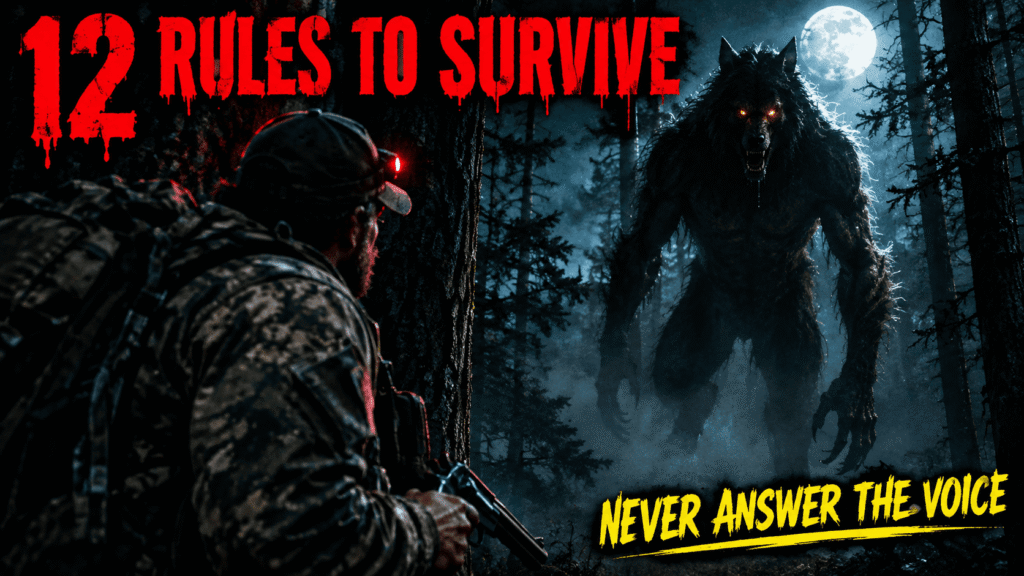
I Survived a Dogman Attack in Land Between the Lakes — 12 Rules That Saved My Life
What you’re about to read comes from a man who spent twenty-two years teaching the U.S. Army how to survive things that hunt people. In October of 2011, in Land Between the Lakes, something put him on the menu. Two men walked out. One didn’t. And the twelve rules he wrote in the years since — rules about silence, fire, and voices in the dark that call your name — have been passed between rangers, hunters, and search-and-rescue teams ever since. Tonight, he’s telling you all of them. Listen carefully. Because if the woods near you ever go quiet all at once… you’ll have ninety seconds to remember this video. Lock your doors. Turn the lights low. This is The Nightmare Zoo.
The first rule is the one nobody believes, so I’m going to say it plain and let you decide. If you are ever in the woods and every living thing goes quiet at the same instant, you are no longer the hunter, the hiker, or the man with the rifle. You are livestock. You have maybe ninety seconds to change that, and what you do in those ninety seconds decides whether somebody finds your truck parked at a trailhead with the keys still in it.
My name is Dale Hutchins. I did twenty-two years in the Army, eleven of them teaching survival evasion resistance and escape out of Fort Bragg, and after I got out I ran a tracking school in the Ozarks outside Jasper, Arkansas, for another fourteen. I have walked out of country on three continents that was actively trying to kill me. I am telling you that so you understand what it costs me to say the next part, which is that nothing I was ever trained on prepared me for what I met in Land Between the Lakes in October of 2011, and that everything I’ve taught since then I built around that one night.
People call it the dogman. I’ve heard it called the beast of the Land Between the Lakes, the Kentucky wolf-thing, half a dozen other names that don’t matter. What matters is what it does, and what it does is hunt people the way a smart man hunts deer, only better, because it studies you while you still think you’re alone. I’m going to give you the rules the way I give them to my students, and I’m going to tell you how I learned each one, because a rule without a body count attached to it is just advice, and advice gets men killed.
Rule one. The silence is your alarm. Treat it like a trip flare.
I was camping with two students that October, running a night navigation exercise in the backcountry north of the Homeplace 1850s farm, up toward the Tennessee line. Nathan Okafor, a wildlife biology grad student out of Murray State, and Brian Tully, a contractor from Paducah who’d paid for the course because he wanted to hunt elk in Montana and not die doing it. Good men. Both of them. I want their names in this because the county report reduced them to a sentence each.
We’d bedded down in a saddle between two ridges, cold camp, no fire, because the exercise was stealth movement. Around eleven I came awake all at once, the way you do when something changes, and I lay there in my bag taking inventory. No crickets. No frogs from the slough down in the draw. No owls. October in that country is loud until it’s not, and it was not. Then came the smell, and I’ll tell you exactly what it was because smell is data: wet dog, skunk musk, and underneath both a coppery butcher-shop reek, so strong I tasted it at the back of my throat.
Nathan whispered from six feet away. “You smell that?”
“Don’t move,” I said. “Don’t sit up. Talk low.”
That was the moment rule one was born. The silence is not peace. The silence is every prey animal in a square mile holding its breath because something with teeth has entered the area. When the woods go quiet you do not sit up, you do not shine a light, you do not call out asking who’s there. You get your weapon in your hand while lying flat, you put your back against something solid, and you start counting. Because the second rule is about time.
Rule two. You have less time than you think, and it uses that time watching you.
Predators read body language. A cougar will watch a herd for an hour before it commits. This thing watches longer, and here’s the part that still wakes me up: it watches from close. We found sign afterward, twenty-five yards from where we’d slept. Flattened leaves in a crouch-spot behind an oak, drag marks where something heavy had shifted its weight again and again. It had been there while we cooked. While we laughed about Brian’s snoring. While I taught Nathan how to read a compass by starlight. It watched us the way you’d watch a car you’re thinking about buying.
I heard it before I saw it. Breathing. Slow, deliberate, wrong. Too big a chest behind it. Then it moved between me and the ridge line and I saw it against the stars, and I will describe it once and only once. Seven and a half feet, standing on two legs as easy as you stand in your kitchen. Shoulders like a doorframe. A wolf’s head, but wrong, the muzzle shorter and heavier, and the ears did a thing no dog’s ears do. They turned independently, one toward me, one toward Nathan’s sleeping bag, tracking us separately. And the eyes threw back what little light there was, not green, not red. Orange. Dull orange like the last coals in a stove.
It knew I was awake. I knew it knew. We stayed like that for what my watch said was four minutes and what my body said was most of my life.
Then Brian sat up in his bag and said, “Guys? Why’s it so quiet?”
Rule three. Never run downhill, and never run at all if you haven’t seen it commit. Running is a trigger, not an escape.
The thing crossed twenty-five yards faster than I can write this sentence. Nathan got his bag unzipped and his legs out, which saved his life. Brian never got his boots on. It hit him low, one arm, the way a man would clothesline a runner, except the arm was corded muscle and claws and Brian came apart at the middle like a sack of wet gravel. I am not going to give you the sounds. I’ve had fourteen years to learn to sleep through them and I haven’t managed it yet. What I will give you is the lesson, because Brian’s death bought it and it would be a sin to waste it.
He ran. Not even away from it. He half-ran, half-crawled toward the creek in the draw, downhill, in the dark, and downhill in the dark is where it wants you. It’s faster than you everywhere, but on a slope it can drop to four limbs and cover ground at a speed I’ve estimated at thirty-five miles an hour, maybe more. Nathan was sprinting too, uphill toward the saddle because he’d heard me say once that high ground is safety, and that was the only thing either of us did right all night. Uphill it has to stay on two legs, and on two legs it’s merely inhumanly fast instead of uncatchable.
I did not run. I did the thing SERE school beats into you, which is control the little picture when the big picture is screaming. I got my pack against my back, my Ruger .44 in my hand, and I backed up the slope with my eyes on the tree line where Brian had gone, and I did not look at the draw. Not once. What was happening to Brian was not survivable and not interruptible, and that sentence is why some of you will hate me, and I can live with that.
Rule four. Light is a weapon, but only in bursts. Constant light is a confession.
Here’s what I mean. A flashlight left on tells it exactly where your eyes are, exactly where your hands are, and it blinds you to everything outside the cone. A flashlight snapped on and off shows you where it is and gives it nothing to aim at. I lit my headlamp in half-second pulses as I climbed. Red, then off. Red, then off. On the third pulse I saw it coming up the slope after Nathan, and on the fourth it had closed half the distance, and I understood something that froze me worse than the eyes had.
It was pacing him. It could have taken him any time it wanted. It was driving him, the way a sheepdog drives a ewe, toward the saddle and over it, toward the far slope where the ground drops into the Honker Lake bottoms, three hundred acres of knee-deep black water and cypress knees. It had a place it wanted him. This thing wasn’t feeding. Feeding is quick. This was something else. This was procedure. It had a kill zone and it was herding him into it.
I fired four rounds over its left shoulder. Not at it. Over its shoulder, close enough that the muzzle blast and the crack would slap it. A .44 Magnum at that range, in that chest, would have done damage, and I had six shots and one lifetime to use them. But shooting it would have told it I was committed to a fight, and you do not commit to a fight you cannot finish. You break contact. That’s rule five, and it’s the one that goes against every movie you’ve ever seen.
Rule five. You are not trying to kill it. You are trying to become not worth the cost.
Every predatory animal on earth runs the same math. Injury equals death. A wolf with a broken jaw starves. A cougar with a torn flank dies of infection. So the whole game is cost. You make yourself expensive. You make noise that says you are not prey, because prey runs quiet and predators make noise. You put fire between you and it if you have fire. You put distance between you and it if you have legs. You put a bullet near it if you have a gun, and you let it feel the air split, and you keep backing away, and you never, ever turn your back, because turning your back is the single most provocative thing a primate can do. Everything with fangs reads a turned back as consent.
Nathan crested the saddle and kept going, and I screamed at him. “Stop! Hold the saddle! Don’t go down the far side!”
He stopped. God kept that boy’s ears open, because he stopped. He came back to me on the ridge line, and we stood back to back on the highest ground for a mile, and I snapped the headlamp red, off, red, off, and between pulses I counted six places at the tree line where the undergrowth was moving against the wind.
Six places. I want to be careful here, because this is where people stop believing me, and I would rather you doubt me and remember the rule than believe me and forget it. So rule six, and I will not argue about it.
Rule six. Assume it is not alone. If you only plan for one, the second one kills you.
I have told this story to rangers, to game wardens, to two men I served with who run predator control in Idaho now. All of them got quiet at the same spot, and it’s this spot. Because one big animal is a rogue. Six moving shapes is a behavior, and behavior means it happens again, and it means it’s happening somewhere right now while you’re reading this. In 2011 I let myself believe it was brush moving, deer spooked up by the noise, my own nerves. In 2019 a man I trust showed me trail camera stills from the Shawnee National Forest in southern Illinois, outside Harrisburg, and there were two of them in one frame, a hundred yards apart, flanking a deer run. Flanking. That’s a tactic. That’s two hunters with a plan.
We held that ridge until a little after four in the morning. Three times it tested us. Each time the same way. The smell first, rolling up the slope ahead of it like weather. Then the breathing, placed deliberately where we’d hear it, because I am certain now it wanted us to hear it, wanted us scared, because a frightened animal makes mistakes. Then a rush from a different direction each time, stopping just outside the light. Nathan kept his cool and kept count with me, and between us we had thirteen rounds and one headlamp and the discipline to do nothing stupid. The third rush came within ten feet. I could hear its feet in the leaves, each step the weight of a full-grown man and then some, and I put the last rounds I was willing to spend into the ground at its approach and it slid to a stop and stood there, breathing, close enough that I could see steam off its shoulders in the red pulse of the lamp.
Then it spoke.
I’m going to lose the rest of you here, and I don’t care anymore. It made a sound with the shape of words in it. Not words. Something that had learned what words sound like, the way a starling learns a car alarm. Low, from the chest, with pauses in the right places, rising and falling the way speech rises and falls, and under it a growl that never stopped. It was mimicking the rhythm of a man talking. And the worst part, the part I have never said out loud before tonight, is that the rhythm it used was Brian’s. The cadence of Brian’s voice, the way he said “Guys? Why’s it so quiet?” Slower. Flattened. But his.
Rule seven. If it talks, it’s already inside your head. Do not answer it. Do not follow it. It only mimics what it has heard, and it only uses voices when it wants you to come to it.
There are reports, and I’ve collected a lot of them since that night, from Michigan’s Huron National Forest, from the Ozark-St. Francis country near Mountain View, from the Hoosier backcountry down in Indiana. Different details, same spine. A voice in the dark calling your name. Your wife’s voice from the tree line at two in the morning. A kid’s voice crying from a logging road. And every person who walked toward the voice is a person whose story ends there, told by somebody else at a search-and-rescue debrief. It baits the hook with the sound of the thing you love. That is not animal behavior. That’s worse. That’s a hunter who’s learned what we’re hungry for.
I’ll give you one of those reports in full, because it’s the one that turned me from a survivor into a collector. Huron National Forest, 2016, up along the Au Sable River outside Mio, Michigan. A retired schoolteacher named Carol Whitaker and her brother were doing a two-night canoe trip, late September, and they’d camped on a gravel bar the way canoe people do, low ground, water on three sides, a game trail behind them. If you’ve been paying attention you already know that campsite broke every rule I hadn’t written yet. Sometime after midnight Carol heard her brother’s voice from the tree line calling her name, except her brother was in the tent next to her, and she could hear him snoring. She did the single smartest thing anyone in any of my files has ever done. She woke him, they built the fire up until it was the size of a bonfire, and they stood in the light with a camp axe and a flare gun until sunrise. In the morning they found the gravel bar circled. Prints, two-toed in some places, padded in others, a full loop around both tents, and on the far side, where the game trail met the bar, a spot where something had sat in the brush for a long time. Long enough that the frost had melted off the leaves under it. They paddled out at first light and Carol mailed me her account in handwriting that got steadier as it went, and at the bottom she wrote a line I’ve read a hundred times: “It knew our names. It had only heard them once, at the put-in, from the outfitter.” That’s the part I can’t file under bear. It listens before it hunts. It learns your name so it can hand it back to you in the dark, from the wrong direction, in a voice that isn’t quite finished.
Dawn came up over Kentucky Lake grey and flat, and with first light it left. No drama. The smell thinned, the woods restarted one bird at a time, and Nathan and I walked six miles to the nearest paved road without speaking. We found Brian in the draw, or we found enough of him to bury. The official finding was animal attack, bear suspected, and nobody with a badge wanted to hear about anything that stood on two legs and studied your sleep habits. I testified at the inquest and I told the truth and I watched the coroner write down “bear.”
I quit teaching for two years. I drank some. Then one night in 2013 I got a call from a sheriff’s deputy in Trigg County, Kentucky, because a Boy Scout troop had come out of the backcountry near Golden Pond missing one leader and telling a story nobody wanted to write down, and the deputy had found my name in a file somewhere. The leader was never found. What was found, up on a ridge, was a campsite arranged the way ours had been arranged, the gear pulled out of packs and laid in rows, every ziplock bag opened with something that wasn’t fingers and not eaten, just opened, examined, discarded. Like it was learning us. That’s when I stopped drinking and started writing the rules.
So here they are, all of them, and I want you to carry them the way I carry them.
Rule eight. Shape the ground before the ground shapes you. Sleep on high ground with your back against rock or a deadfall you built yourself, never in a draw, never near water, never on a game trail. It uses trails. It is faster than you on a trail the way you’re faster than a fish on a dock.
Rule nine. Fire is the one language it respects. It watched us from outside firelight for six hours and never once crossed it. If you are in country where the silence has fallen and the smell is on the wind, you build the biggest fire you can feed and you stay inside its light until the sun does your job for you. Every story I’ve verified where the person lived, there’s fire in it somewhere. Every story where they didn’t, there isn’t.
Rule nine-and-a-half, if you’ll let me have it. Dogs. A dog is the best early-warning system a man can carry into those woods, but you have to read it right. When the thing is close, a dog does not bark. A dog that barks at bears, at coyotes, at shadows all its life will go rigid and silent when this is near, and some of them will press into you and some of them will try to hide under you, and a few, the brave ones, will put themselves between you and the dark and make a sound so low you’ll feel it in your feet before you hear it. Whatever yours does, believe it. Every survivor account I have that includes a dog includes a paragraph where the dog knew first. Every account where the dog ran into the dark after it ends the same way, and I won’t pretend otherwise. You keep your dog close, you keep it leashed or commanded after sunset, and when it goes quiet and stiff and stares at one fixed point in the black, that point is where it is, and you do not shine your light there. You back away from there, into your firelight, and you let the dog’s eyes do the pointing.
Rule ten. Mark your exit the moment you arrive. Before you pitch a tent, before you cook, you walk a line to your vehicle or to a road and you mark it so you can run it blind, because if you have to move at night you will be moving blind, and a man running blind in the woods is just meat with momentum. I’ve taught this to deer hunters for years and most of them nod and never do it. The ones who do it are the ones who come find me later and buy me coffee with shaking hands.
Rule eleven. Travel in threes, never twos, and never alone. Two is a couple. Three is a problem. I don’t know why the number matters but it shows up in the pattern too often to ignore. Pairs vanish. Solo hikers vanish more. Three or more, something usually survives to tell it. Nathan lived because there were three of us. Do that math however you want; I’ve done it every October for fourteen years.
Rule twelve, the last one, and the one that matters most. If you see it, leave the area and never go back, and tell someone with authority even if they laugh. Especially if they laugh. Because the laughter goes in a report, and reports have files, and files have patterns, and someday somebody is going to lay those patterns side by side and see what I’ve seen. Land Between the Lakes. Shawnee. The Huron country. The Ozarks. The same silhouette, the same silence, the same smell, decade after decade, county by county, and every year a few more empty campsites and a few more trucks at trailheads with the keys still in them.
I still go into the woods. People ask how I can, and the honest answer is I can’t not. But I go different now. I go with a fire laid before dark, on high ground, in threes, with a dog that sleeps across my feet, because a dog will tell you what the crickets already told you, if you’ve learned to listen. I go with thirteen rounds and a headlamp set to red. And every single time, when the woods go quiet, I lie flat and I put my back to something solid and I count, and I wait to see if I’m the teacher that night or the lesson.
Nathan Okafor finished his doctorate. He teaches in Oregon now, and he will not camp east of the Rockies, and he answers my calls on the first ring, every time. Once a year, in October, he calls me, and neither of us says Brian’s name, and both of us hear it anyway, rising and falling in the dark, shaped like words.
You wanted to know if there are rules for surviving a dogman encounter. There are. I wrote them in blood that wasn’t mine, and I’m asking you to learn them so it never has to be yours. The silence is the alarm. The light is a weapon. High ground, fire, threes, a marked exit, and never your back. And if a voice you love calls you from the tree line in the dark, it is not the voice you love. It is the thing that heard it last.
Stay out of the draw. Stay inside the firelight. And if you see it, come find me. I keep the coffee on, and I believe you.
If Dale’s rules saved a place in your memory tonight, do him one favor — share this video with someone who camps, hunts, or hikes alone. You never know whose ninety seconds it might buy. And if you’ve had your own encounter — the silence, the smell, a voice calling your name from the tree line — drop it in the comments.